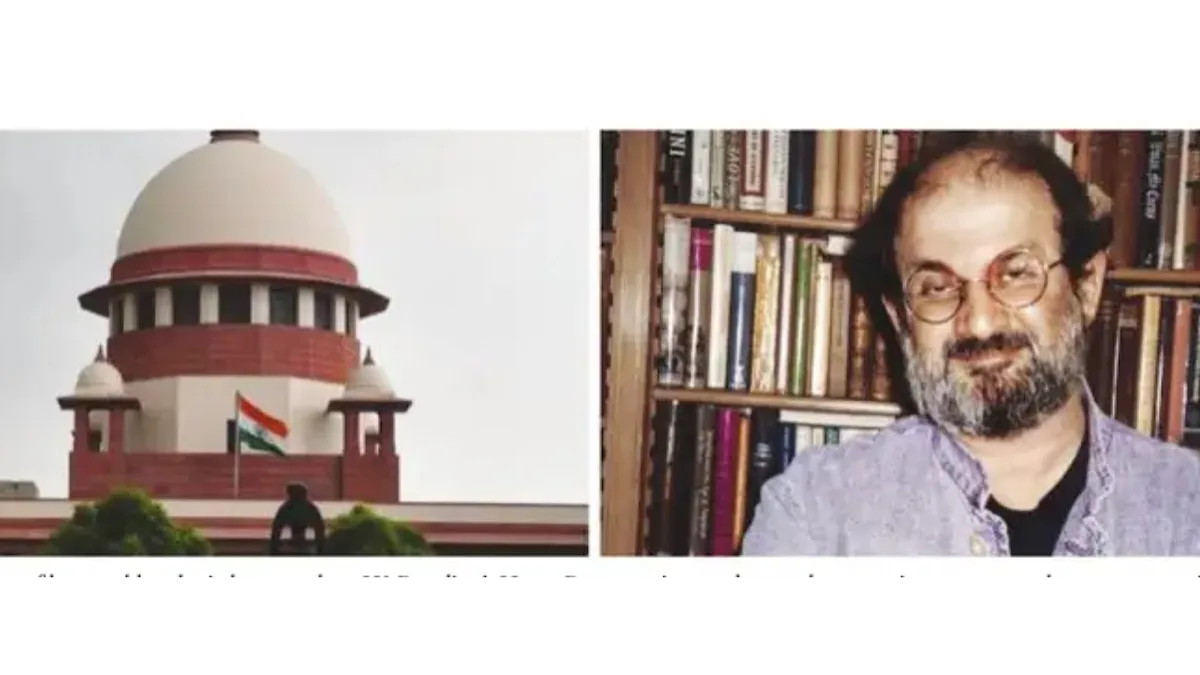
When the Supreme Court of India recently dismissed a petition to ban Salman Rushdie’s The Satanic Verses, it sent out a powerful message: book banning is a relic of the past. In an age where information travels faster than ever before, censorship of literature is both futile and regressive. What once may have been enforced by governments with confiscations and customs checks is now undone by a simple download link, a digital library, or a shared PDF file. The attempt to control the spread of ideas by banning books is like trying to stop a flood with bare hands.
It is a battle already lost. The case of The Satanic Verses epitomizes the futility of book banning. Published in 1988, Rushdie’s novel sparked a global firestorm. It was accused of blasphemy, banned in several Muslim-majority countries, and outlawed in India within days of release. Iran’s Ayatollah Khomeini issued a fatwa against the author, making Rushdie a target for decades. Translators and publishers faced violent reprisals, and Rushdie himself survived an assassination attempt as recently as 2022. Yet despite the bans and threats, the book has remained in circulation worldwide. This pattern repeats itself across history. In South Asia, Taslima Nasrin’s Lajja (1993) was banned in Bangladesh for allegedly insulting religious sentiments.
Advertisement
The ban, far from silencing her, propelled the book to international fame. It was translated into more than 20 languages and became a symbol of the struggle for free expression in the face of authoritarian control. Readers who might never have heard of Nasrin rushed to find her work precisely because the government tried to erase it. The lesson is simple: the forbidden fruit is often the sweetest. The history of banned books is long and diverse. D.H. Lawrence’s Lady Chatterley’s Lover was prohibited in Britain, the United States, and India for its explicit portrayal of sexuality. The infamous British obscenity trial in 1960, where the prosecution asked whether it was a book one would “wish your wife or servants to read,” ended with an acquittal that reshaped the cultural landscape. Today, Lawrence’s novel is part of the canon, studied in classrooms and celebrated as literature.
The ban, once taken so seriously, now seems absurd. The Catholic Church’s Index Librorum Prohibitorum ~ a list of forbidden books maintained from 1559 until 1966 ~ shows how censorship was once systematized. Works by Galileo Galilei, Jean-Paul Sartre, and even Voltaire were condemned. Yet many of these writers now stand at the centre of world intellectual heritage. The Church abandoned the list not because the books became less controversial, but because it became clear that prohibition in an age of mass printing was impossible to enforce. The same truth applies today with digital media, only magnified a thousandfold. Dan Brown’s The Da Vinci Code (2003) demonstrates how modern societies still flirt with censorship. Several countries debated banning the book and its film adaptation for alleged blasphemy.
Some Indian states temporarily blocked its screening. But far from deterring readers, the controversy turned the novel into a global bestseller. With over 80 million copies sold, it remains one of the most widely read thrillers of all time. The attempt to silence only amplified its allure. Globally, there are countless examples. George Orwell’s Animal Farm, a satirical allegory of authoritarianism, was banned in the Soviet Union and several Eastern Bloc countries. Yet the book not only survived but became a timeless critique of political repression. In the United States, Harper Lee’s To Kill a Mockingbird and Mark Twain’s Adventures of Huckleberry Finn have faced challenges for their depictions of race.
Ironically, these works that once offended sensibilities are now pillars in debates about justice, equality, and America’s moral struggles. Even fantasy fiction has not been spared. J.K. Rowling’s Harry Potter series was banned in some schools and communities in the United States for allegedly promoting witchcraft. In the Middle East, it faced restrictions for similar reasons. But the bans only intensified its mystique. Today, Harry Potter is a global cultural phenomenon, its readers numbering in the hundreds of millions. The children who were once told not to read it are now adults passing the books to their own children.
James Joyce’s Ulysses is another example of how censorship ultimately collapses under the weight of literary merit. Once branded obscene and banned in both the United States and the United Kingdom, the book was smuggled in by determined readers and publishers. Today, it is hailed as one of the greatest modernist novels of the 20th century. The world remembers the bans as footnotes; the book itself lives on as a milestone of literature. These examples underline two truths: first, that banning a book is almost always an admission of fear ~ fear of new ideas, of dissent, of cultural change; and second, that bans are inherently counterproductive. What is forbidden becomes desirable.
What is censored gains power. In the age of the internet, the futility of bans is even clearer. A book that is prohibited in one country can be purchased online from another. PDFs circulate freely, often within hours of a ban being announced. Social media creates buzz around the controversy, ensuring more people hear of the book than would have without censorship. The tools of suppression are overwhelmed by the tools of sharing. Governments that still attempt bans appear increasingly out of step with reality, as though they are trying to trap ideas in a box that no longer exists. The argument for banning books is usually couched in noble terms: protecting society from obscenity, shielding faith from insult, preventing unrest. But these rationales ignore the intelligence and agency of readers.
Readers are not passive sponges; they can question, reject, and debate what they encounter. Shielding them from ideas is both patronizing and undemocratic. The true test of a mature society is not in its ability to silence writers but in its willingness to engage with them ~ even when their ideas offend. More importantly, book banning stifles growth. Literature thrives on discomfort. The books that provoke outrage are often the ones that force societies to confront uncomfortable truths. Lajja confronted communalism, Lady Chatterley’s Lover challenged sexual repression, The Satanic Verses pushed boundaries on faith and identity. To suppress these works is to deny society the chance to wrestle with its own contradictions. What history shows, time and again, is that books outlive bans.
The Index of Forbidden Books is gone, but Voltaire remains. The obscenity trials are forgotten, but Lawrence and Joyce endure. Nasrin is still read; Rushdie is still debated; Rowling is still celebrated. The bans, meanwhile, survive only as historical embarrassments ~ a record of fear, intolerance, and resistance to change. As India’s Supreme Court has now affirmed in Rushdie’s case, the age of banning books should be behind us. The information superhighway has changed the game forever. To ban a book today is not just futile; it is an act of willful blindness to the realities of the digital era. If a work offends, the solution is dialogue, debate, and counter-narrative – not censorship. For every attempt to silence, there will be readers who seek.
For every ban, there will be a backchannel of circulation. For every act of suppression, there will be an act of resistance. The written word is resilient. It slips through cracks, leaps across borders, and endures in ways its censors cannot imagine. Banning books is not a sign of strength but of insecurity. It does not protect societies; it infantilizes them. In the long run, books remain, ideas survive, and bans are consigned to history’s dustbin. In the age of the information superhighway, to attempt censorship is to fight a war already lost. The only path forward is openness ~ the courage to read, to argue, and to let ideas, however uncomfortable, compete freely in the marketplace of thought.
(The writer is Professor, Centre For South Asian Studies, Pondicherry Central University)